

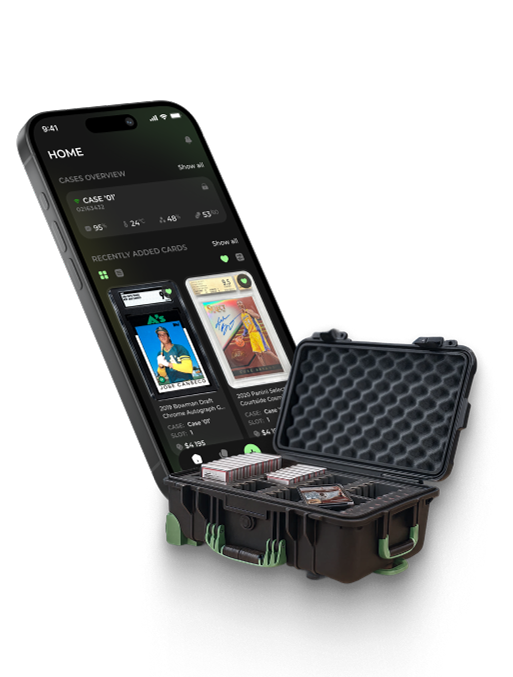
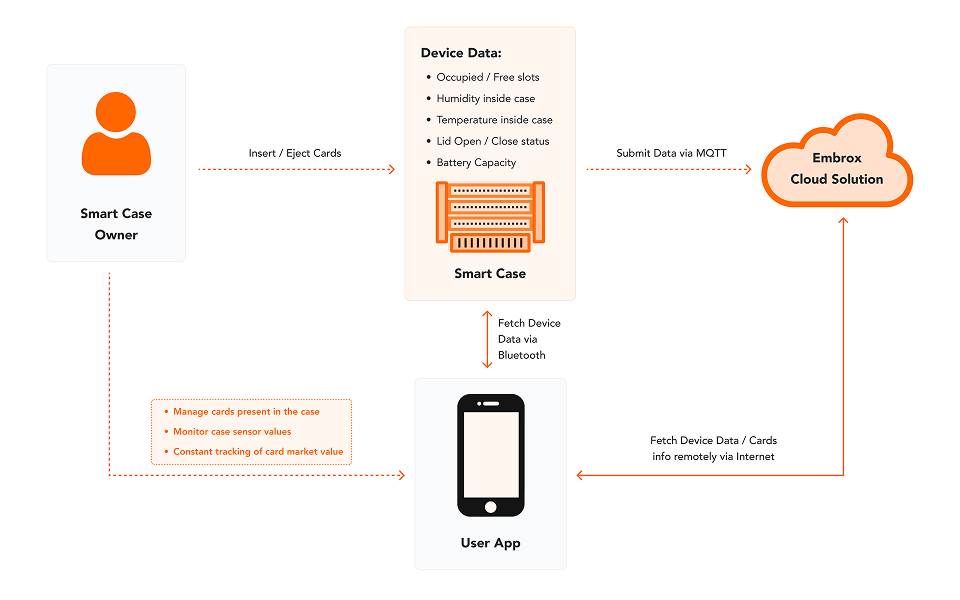
The Hobby Smart Case is an innovative storage and management solution for graded sports card collectors. Designed as a portable briefcase, it securely holds up to 60 cards, with each slot featuring card detection and bi-color LED indicators. The case integrates with a mobile app via BLE, offering real-time inventory tracking, environmental monitoring, and status updates. Users can manage collections through barcode scanning, database search, or manual entry, with support for syncing up to 5 cases per account. Hardware features include Wi-Fi readiness, a 7000mAh battery, and USB-C fast charging with OTA firmware updates. The mobile app provides a user-friendly interface, live card metrics, and easy organization of large card portfolios. This solution modernizes the way collectors protect, access, and grow their card collections.
Challenges
What was the client's main problem?
The client wanted to create a modern, smart solution that would help collectors securely store their graded sports cards while also allowing them to easily manage and track their collections. He aimed to combine physical protection with digital inventory management, real-time status monitoring, and seamless mobile integration to enhance the overall collecting experience.
What was Embrox's team challenge?
Developing a reliable card slot detection system
Designing a power-efficient firmware
Enabling accurate card recognition via mobile camera
Engineering a compact mechanical layout that fits all electronic components, provides secure card holding, and maintains structural integrity in a portable briefcase format
How were these challenges overcome?
We implemented a hardware-based detection mechanism using precision limit switches and paired them with bi-color LEDs controlled by the microcontroller. Extensive testing was conducted to ensure accurate detection under real-world handling conditions.
Our firmware engineer optimized the firmware to operate in multiple power modes, leveraging deep sleep for idle states while still enabling periodic sensor reads and BLE communication. Critical functions were carefully timed to minimize energy consumption and extend battery life.
To guide users during scanning, the team designed an on-screen card frame overlay, helping them position the card correctly. We utilized Google ML Kit for on-device text recognition and integrated third-party APIs to automatically match the extracted text with the correct card from external databases.
The team created multiple design iterations to tightly integrate all hardware components within the available enclosure space. Custom-designed card slots, layered PCB layouts, and modular assembly methods were used to ensure both functionality and structural rigidity.
Our Approach
Embrox took a collaborative and iterative approach to ensure the client’s vision was fully realized. The team worked closely with the client to refine technical requirements, prioritize features, and align hardware, firmware, and app development into synchronized milestones. Early prototypes were shared for validation, allowing fast feedback loops and timely adjustments. Emphasis was placed on usability, scalability, and future-proofing—ensuring the system could evolve with growing collections and additional features. Regular demos, transparent communication, and technical documentation kept the client involved throughout the process, building trust and ensuring alignment at every stage.

What Our Team Says


As the lead mobile developer for the Hobby Smart Case app, I focused on building an intuitive tool that helps collectors manage and track their graded cards with ease. From inventory tracking to real-time market insights, I aimed to bring real value to the community. It’s been exciting to blend mobile tech with IoT to enhance the collecting experience.


Would you like to collaborate with us?
Have an idea or project? Fill out the form below, and we'll get back to you as soon as possible.